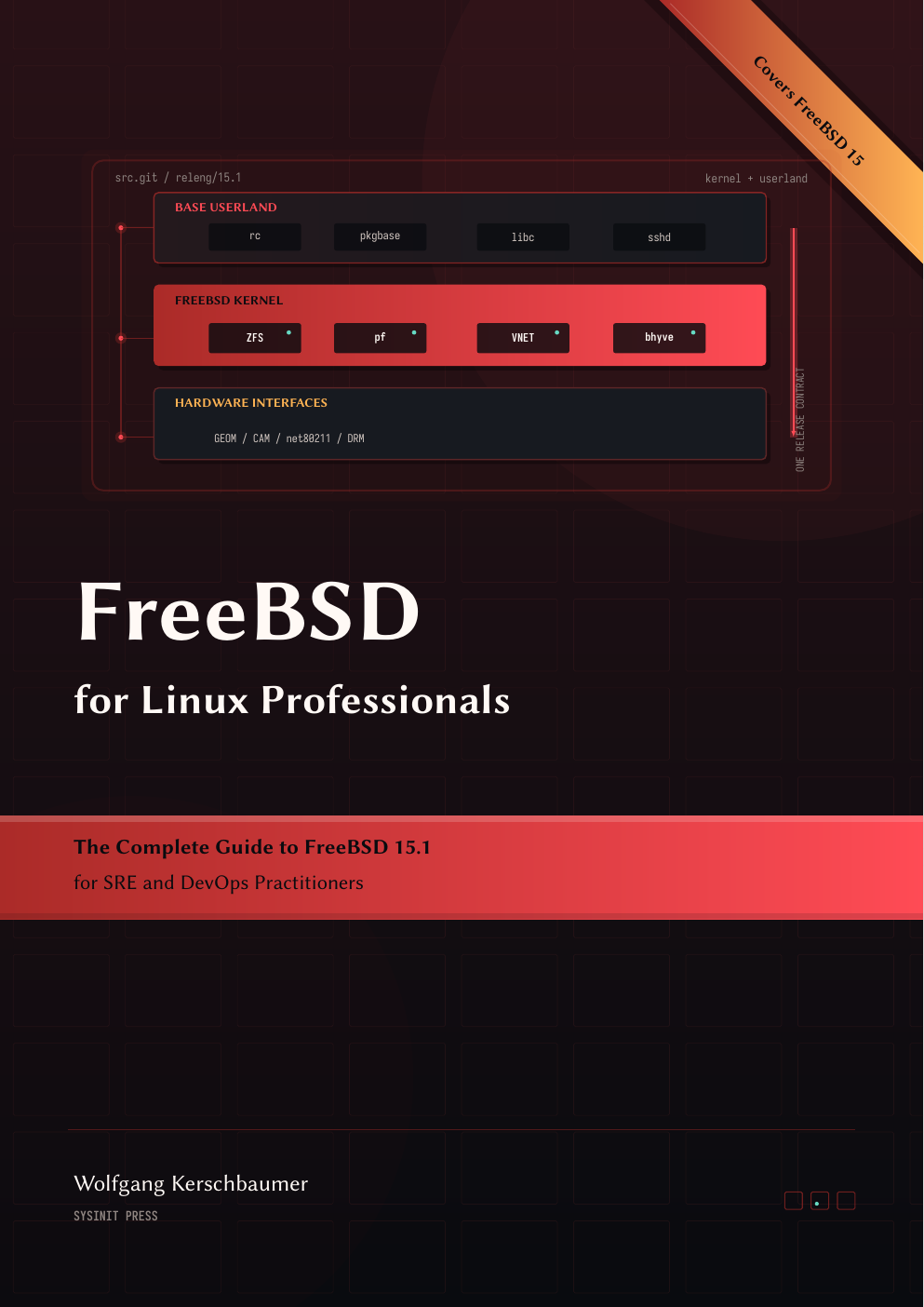
FreeBSD for Linux Professionals
The Complete Guide to FreeBSD 15.1 for SRE and DevOps Practitioners.
Early access
The book uses Linux as the starting point for learning FreeBSD. A translation table maps familiar commands and system concepts, then the chapters explain the base system, ZFS, jails, bhyve, and pf on their own terms. Examples run in a reproducible Proxmox lab built with OpenTofu. Later chapters cover the boot process, daily operations, and source builds.
Status: all 32 chapters and 7 appendices are written and lab-verified on FreeBSD 15.1-RELEASE; final editing and the cover remain. Early access includes the current build as PDF and EPUB, the examples archive, the audiobook edition, and every build until release.
Polar handles the secure checkout. The finished book ships DRM-free as PDF and EPUB, with free updates.
Reader poll Readers pick which Sysinit Press title we finish next. FreeBSD for Linux Professionals is on the ballot.
Vote for this bookLearn FreeBSD through the Linux concepts you already know.
The opening chapters translate Linux habits into FreeBSD concepts and build the lab. Later parts cover boot and services, storage, networking, jails, bhyve, and production operations. The final parts examine the kernel, userland, and ecosystem. Open a part to see its chapters.
What this book assumes, and how to read it
Part 1 Orientation 3 chapters
- 1 One System, Whole: The FreeBSD Model
- 2 The Translation Table: FreeBSD for Linux Eyes
- 3 The Lab: FreeBSD 15.1 on Proxmox with OpenTofu
Part 2 First Boot to First Service 6 chapters
- 4 Installing FreeBSD: From bsdinstall to Unattended
- 5 The Boot Chain: Firmware to /sbin/init
- 6 Init, rc, and Service Management
- 7 Software Management with pkg
- 8 Users, Authentication, and Login Classes
- 9 Batteries Included: The Base-System Daemons
Part 3 Storage and Data 4 chapters
- 10 GEOM and UFS: The Traditional Storage Stack
- 11 ZFS Fundamentals
- 12 ZFS in Operation
- 13 Backup and Disaster Recovery
Part 4 Networking 3 chapters
- 14 The Network Stack: Links, Routes, and TCP
- 15 Plugging In: DHCP, IPv6, and Name Resolution
- 16 Firewalls: pf, ipfw, and Traffic Shaping
Part 5 Compartments: Jails and Virtual Machines 3 chapters
- 17 Jails: The Model
- 18 Jails in Production
- 19 bhyve: Virtual Machines
Part 6 Production Operations 6 chapters
- 20 Staying Current: pkgbase, freebsd-update, and Security Advisories
- 21 Cross-OS Interop: SMB, NFS with Linux, and Foreign Disks
- 22 High Availability: CARP, pfsync, and HAST
- 23 Security Architecture and Hardening
- 24 Observability: DTrace, Tracing, and Crash Dumps
- 25 Performance Tuning
Part 7 Under the Hood 4 chapters
- 26 The Kernel: GENERIC, Modules, and sysctl
- 27 Building Your Own: Ports and poudriere
- 28 Building FreeBSD from Source
- 29 The Developer's FreeBSD: Toolchain and Contributing
Part 8 Ecosystem and Interop 3 chapters
- 30 The Linuxulator: Running Linux Binaries
- 31 FreeBSD on Your Hardware: WiFi, Graphics, and the Desktop
- 32 The Project: Governance, Releases, and the Adoption Playbook
Part 9 Appendices 7 appendices
- A Linux-to-FreeBSD Command and Concept Reference
- B Troubleshooting Playbook
- C Configuration File Reference
- D Removed, Renamed, and Deprecated in 15.x
- E Glossary
- F Sources and Further Reading
- G Subject Index
For engineers who know Linux.
This book is for SRE and DevOps practitioners who run production Linux systems. It assumes fluency with the shell, services, storage, and networking. Readers do not need FreeBSD experience.
- Linux engineers who want the translation table first: every familiar habit mapped to its FreeBSD counterpart.
- Teams evaluating ZFS, jails, bhyve, and pf for production workloads.
- Operators drawn to one coherent base system, with kernel, userland, and documentation released together.
Get early access.
Early access is the book at a reduced price while final editing is in progress. You get the current build as DRM-free PDF and EPUB right after checkout, the examples archive, the audiobook edition as MP3 and chaptered M4B (about 14 hours; the narration is AI-generated), every new build until release, and the finished book at release, with free updates afterwards.
Hear when a new build lands.
The build list announces new early access builds of Sysinit Press titles, each with a short summary of what changed. It carries nothing else.
The signup uses double opt-in. Every message includes an unsubscribe link.
Or wait for the release.
The shared Sysinit Press book list carries release news, sample chapters, and updates to published editions.
The signup uses double opt-in. Every message includes an unsubscribe link.